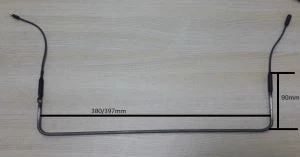
In today's digital age, data centers are the backbone of the global economy, housing vast amounts of servers that process and store an ever - increasing volume of data. As the demand for data storage and processing grows, so does the heat generated by these servers. Efficient thermal management is crucial to ensure the reliable operation of data centers and to reduce energy consumption. This is where heat pipes come into play. As a heat pipe supplier, I am excited to explore the potential of heat pipes in data centers.
The Heat Problem in Data Centers
Data centers are notorious for their high energy consumption and heat generation. Servers, networking equipment, and storage devices produce a significant amount of heat during operation. If not properly managed, this heat can lead to increased temperatures, which can cause equipment failure, reduced performance, and higher maintenance costs. Traditional cooling methods, such as air - cooling and liquid - cooling systems, have been used to address the heat issue. However, these methods often have limitations in terms of efficiency, scalability, and environmental impact.
Air - cooling systems, for example, are relatively simple and cost - effective to install. They use fans to circulate air over the servers to remove heat. However, air has a relatively low heat capacity, which means that large amounts of air need to be moved to dissipate the heat effectively. This requires a significant amount of energy, and the cooling efficiency can be limited, especially in high - density data centers.
Liquid - cooling systems, on the other hand, are more efficient at removing heat than air - cooling systems. They use a liquid, such as water or a coolant, to transfer heat from the servers to a heat exchanger. However, liquid - cooling systems are more complex and expensive to install and maintain. They also require a reliable water supply and proper insulation to prevent leaks, which can cause damage to the equipment.
How Heat Pipes Work
Heat pipes are highly efficient heat transfer devices that can provide a solution to the heat management challenges in data centers. A heat pipe is a closed - loop system that consists of a sealed tube filled with a working fluid, such as water or a refrigerant. The tube has a wick structure on its inner surface, which helps to transport the working fluid from the condenser end to the evaporator end.
When heat is applied to the evaporator end of the heat pipe, the working fluid inside the tube absorbs the heat and evaporates. The vapor then moves to the condenser end of the heat pipe, where it releases the heat and condenses back into a liquid. The condensed liquid is then transported back to the evaporator end by the capillary action of the wick structure. This continuous cycle of evaporation and condensation allows heat pipes to transfer heat very efficiently with a small temperature difference between the evaporator and the condenser.
Advantages of Using Heat Pipes in Data Centers
There are several advantages of using heat pipes in data centers:


High Efficiency
Heat pipes have a very high thermal conductivity, which means that they can transfer heat much more efficiently than traditional cooling methods. They can transfer heat over long distances with minimal temperature drop, making them ideal for use in large - scale data centers.
Energy Savings
By using heat pipes, data centers can reduce their energy consumption significantly. Since heat pipes can transfer heat with a small temperature difference, they require less energy to operate compared to traditional cooling systems. This can lead to substantial cost savings in the long run.
Compact Design
Heat pipes have a compact and lightweight design, which makes them easy to integrate into existing data center infrastructure. They can be used to cool individual components, such as processors and memory modules, or to cool entire racks of servers.
Reliability
Heat pipes are passive devices that do not have any moving parts, which means that they are more reliable and require less maintenance compared to traditional cooling systems. They also have a long service life, which can reduce the overall cost of ownership.
Applications of Heat Pipes in Data Centers
Heat pipes can be used in various applications in data centers:
Component - Level Cooling
Heat pipes can be used to cool individual components, such as processors, graphics cards, and memory modules. By attaching a heat pipe to the component, the heat can be transferred away from the component quickly and efficiently, which can help to improve the performance and reliability of the component.
Rack - Level Cooling
Heat pipes can also be used to cool entire racks of servers. By installing heat pipes in the rack, the heat generated by the servers can be transferred to a heat exchanger at the top or bottom of the rack. This can help to reduce the temperature inside the rack and improve the overall cooling efficiency of the data center.
Data Center - Wide Cooling
In some cases, heat pipes can be used in combination with other cooling technologies, such as air - cooling or liquid - cooling systems, to provide data center - wide cooling. For example, heat pipes can be used to pre - cool the air before it enters the air - cooling system, which can reduce the load on the air - cooling system and improve its efficiency.
Case Studies and Real - World Examples
There are already some successful case studies of using heat pipes in data centers. For example, some large - scale data centers have started to use heat pipes to cool their high - performance servers. These data centers have reported significant energy savings and improved equipment reliability after implementing heat pipe - based cooling solutions.
One such example is a data center that used heat pipes to cool its server racks. The heat pipes were installed in the racks to transfer the heat from the servers to a heat exchanger at the top of the rack. The heat exchanger then transferred the heat to the outside environment using a liquid - cooling system. As a result, the data center was able to reduce its energy consumption by up to 30% and improve the reliability of its servers.
Challenges and Considerations
While heat pipes offer many advantages for data center cooling, there are also some challenges and considerations that need to be addressed:
Cost
The initial cost of installing heat pipe - based cooling systems can be higher compared to traditional cooling systems. However, the long - term energy savings and improved reliability can offset the initial investment.
Compatibility
Heat pipes need to be compatible with the existing data center infrastructure, including the servers, racks, and cooling systems. This requires careful planning and design to ensure that the heat pipe - based cooling system can be integrated smoothly into the existing infrastructure.
Maintenance
Although heat pipes are relatively reliable and require less maintenance compared to traditional cooling systems, they still need to be inspected and maintained regularly to ensure their proper operation. This includes checking the integrity of the heat pipes, the working fluid level, and the wick structure.
Conclusion
In conclusion, heat pipes have great potential for use in data centers. They offer high efficiency, energy savings, compact design, and reliability, which make them an attractive option for addressing the heat management challenges in data centers. As a heat pipe supplier, I am committed to providing high - quality heat pipe products and solutions to help data centers improve their thermal management and reduce their energy consumption.
If you are interested in learning more about how heat pipes can be used in your data center or if you are looking for a reliable heat pipe supplier, please feel free to [initiate a contact for procurement discussions]. We are happy to work with you to find the best heat pipe - based cooling solution for your specific needs.
References
- Bejan, A., & Kraus, A. D. (2003). Heat Transfer Handbook. Wiley.
- Kakaç, S., & Pramuanjaroenkij, A. (2005). Heat Pipes: Science and Technology. Taylor & Francis.
- Wang, Y., & Bullard, C. W. (2011). Energy - efficient data center cooling technologies. Energy and Buildings, 43(8), 2028 - 2035.