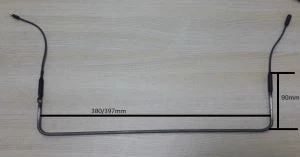
As a heat pipe supplier deeply immersed in the world of thermal management, I've witnessed firsthand the critical role that heat pipes play in a wide range of applications. One frequently debated topic in the industry is how the diameter of a heat pipe affects its performance. In this blog, I'll explore this relationship in detail, drawing on both theoretical knowledge and practical experience.
Basic Principles of Heat Pipes
Before delving into the impact of diameter, it's essential to understand the basic working principles of heat pipes. A heat pipe is a highly efficient heat transfer device that operates on the principles of phase change and capillary action. It consists of a sealed tube, typically made of copper or aluminum, filled with a working fluid such as water or ammonia. The inner surface of the tube is lined with a wick structure that helps to transport the working fluid from the condenser end to the evaporator end.
When heat is applied to the evaporator end of the heat pipe, the working fluid absorbs the heat and vaporizes. The vapor then travels to the condenser end, where it releases the heat and condenses back into a liquid. The condensed liquid is then transported back to the evaporator end by the capillary action of the wick structure, completing the cycle.
Impact of Diameter on Heat Transfer Capacity
One of the most significant ways in which the diameter of a heat pipe affects its performance is through its impact on heat transfer capacity. In general, larger diameter heat pipes have a higher heat transfer capacity than smaller diameter heat pipes. This is because larger diameter heat pipes have a larger cross-sectional area, which allows for more working fluid to be present in the pipe. As a result, more heat can be transferred through the pipe.
However, it's important to note that the relationship between diameter and heat transfer capacity is not linear. As the diameter of the heat pipe increases, the heat transfer capacity also increases, but at a decreasing rate. This is because as the diameter increases, the surface area-to-volume ratio of the heat pipe decreases, which can limit the efficiency of heat transfer.
In addition, the heat transfer capacity of a heat pipe also depends on other factors such as the type of working fluid, the wick structure, and the operating temperature. Therefore, when selecting a heat pipe for a specific application, it's important to consider all of these factors in addition to the diameter.
Impact of Diameter on Thermal Resistance
Another important aspect of heat pipe performance is thermal resistance. Thermal resistance is a measure of how much heat is lost as it travels through a material or device. In the case of heat pipes, thermal resistance is determined by a number of factors, including the diameter of the pipe.
In general, larger diameter heat pipes have a lower thermal resistance than smaller diameter heat pipes. This is because larger diameter heat pipes have a larger cross-sectional area, which allows for more efficient heat transfer. As a result, less heat is lost as it travels through the pipe, and the overall thermal resistance is lower.
However, like the relationship between diameter and heat transfer capacity, the relationship between diameter and thermal resistance is not linear. As the diameter of the heat pipe increases, the thermal resistance decreases, but at a decreasing rate. This is because as the diameter increases, the surface area-to-volume ratio of the heat pipe decreases, which can limit the efficiency of heat transfer.
In addition, the thermal resistance of a heat pipe also depends on other factors such as the type of working fluid, the wick structure, and the operating temperature. Therefore, when selecting a heat pipe for a specific application, it's important to consider all of these factors in addition to the diameter.
Impact of Diameter on Pressure Drop
Pressure drop is another important factor to consider when evaluating the performance of a heat pipe. Pressure drop refers to the difference in pressure between the evaporator end and the condenser end of the heat pipe. In general, larger diameter heat pipes have a lower pressure drop than smaller diameter heat pipes.
This is because larger diameter heat pipes have a larger cross-sectional area, which allows for more fluid to flow through the pipe with less resistance. As a result, the pressure drop is lower, and the overall efficiency of the heat pipe is higher.
However, it's important to note that the relationship between diameter and pressure drop is also not linear. As the diameter of the heat pipe increases, the pressure drop decreases, but at a decreasing rate. This is because as the diameter increases, the surface area-to-volume ratio of the heat pipe decreases, which can limit the efficiency of fluid flow.
In addition, the pressure drop of a heat pipe also depends on other factors such as the type of working fluid, the wick structure, and the operating temperature. Therefore, when selecting a heat pipe for a specific application, it's important to consider all of these factors in addition to the diameter.
Impact of Diameter on Cost
Finally, it's important to consider the impact of diameter on cost when selecting a heat pipe for a specific application. In general, larger diameter heat pipes are more expensive than smaller diameter heat pipes. This is because larger diameter heat pipes require more material to manufacture, and they may also require more complex manufacturing processes.


However, it's important to note that the cost of a heat pipe is not the only factor to consider when selecting a heat pipe for a specific application. Other factors such as heat transfer capacity, thermal resistance, pressure drop, and reliability are also important considerations. Therefore, when selecting a heat pipe, it's important to balance the cost with the performance requirements of the application.
Conclusion
In conclusion, the diameter of a heat pipe has a significant impact on its performance. Larger diameter heat pipes generally have a higher heat transfer capacity, lower thermal resistance, lower pressure drop, but they are also more expensive. When selecting a heat pipe for a specific application, it's important to consider all of these factors in addition to the diameter.
At our company, we offer a wide range of heat pipes with different diameters to meet the diverse needs of our customers. Whether you need a small diameter heat pipe for a compact application or a large diameter heat pipe for a high-power application, we have the expertise and experience to provide you with the right solution.
If you're interested in learning more about our heat pipes or have any questions about how the diameter of a heat pipe affects its performance, please don't hesitate to contact us for procurement discussions. We look forward to working with you to find the best heat pipe solution for your application.
References
- Incropera, F. P., & DeWitt, D. P. (2002). Fundamentals of heat and mass transfer. John Wiley & Sons.
- Kakaç, S., & Pramuanjaroenkij, A. (2005). Heat pipes: science and technology. Taylor & Francis.
- Peterson, G. P. (1994). An introduction to heat pipes: modeling, testing, and applications. John Wiley & Sons.