As a seasoned heat tubes supplier, I've witnessed firsthand the transformative impact of well - designed heat tube systems across various industries. In this blog, I'll share insights on how to design a heat tube system for maximum efficiency.
Understanding the Basics of Heat Tubes
Heat tubes, also known as heat pipes, are highly efficient heat transfer devices. They operate on the principle of phase change. Inside a sealed tube, there is a working fluid. When heat is applied at one end (the evaporator section), the working fluid absorbs the heat and evaporates. The vapor then travels to the cooler end (the condenser section), where it releases the heat and condenses back into a liquid. The capillary action of a wick structure inside the tube then returns the liquid back to the evaporator section, completing the cycle.
To design an efficient heat tube system, one must first understand the properties of the working fluid and the wick structure. Different working fluids have different boiling points, latent heats of vaporization, and thermal conductivities. For example, water is a common working fluid for heat tubes operating at moderate temperatures due to its high latent heat of vaporization and good thermal conductivity.
System Design Considerations
Heat Load Calculation
Determining the heat load is the first step in designing an efficient heat tube system. This involves calculating the amount of heat that needs to be transferred from the heat source to the heat sink. Factors such as the power consumption of the heat - generating equipment, the ambient temperature, and the desired temperature of the equipment need to be considered. A precise heat load calculation ensures that the heat tube system is neither oversized nor undersized. An oversized system will be more expensive and may not operate at its optimal efficiency, while an undersized system will not be able to transfer the required amount of heat.
Tube Geometry and Configuration
The geometry and configuration of the heat tubes play a crucial role in system efficiency. The length, diameter, and number of heat tubes need to be carefully selected. Longer tubes generally have a higher heat transfer capacity but may also have higher pressure drops, which can reduce the efficiency of the system. The diameter of the tube affects the flow rate of the working fluid and the capillary action of the wick. A larger diameter tube may allow for a higher flow rate but may also require a more robust wick structure.
In terms of configuration, parallel and series arrangements are commonly used. A parallel arrangement allows for a higher overall heat transfer rate as the heat load is distributed among multiple tubes. On the other hand, a series arrangement can be useful in applications where a large temperature difference needs to be maintained between the heat source and the heat sink.
Heat Source and Sink Design
The design of the heat source and sink is also important. The heat source should be in good thermal contact with the evaporator section of the heat tube. This can be achieved through the use of thermal interface materials such as thermal grease or pads. The heat sink should have a large surface area to facilitate efficient heat dissipation. Fins are often added to the heat sink to increase its surface area.
Material Selection
The choice of materials for the heat tube, wick, and working fluid can significantly impact the efficiency of the system.
Tube Material
The tube material should have good thermal conductivity and be compatible with the working fluid. Copper is a popular choice for heat tubes due to its high thermal conductivity and corrosion resistance. Aluminum is also used in some applications, especially when weight is a concern, as it is lighter than copper but has a lower thermal conductivity.
Wick Material
The wick material is responsible for returning the condensed liquid to the evaporator section. Common wick materials include sintered metal powders, wire meshes, and grooves. Sintered metal powder wicks offer high capillary forces and good liquid - flow characteristics, making them suitable for high - performance applications. Wire mesh wicks are relatively easy to manufacture and can be used in a wide range of applications. Grooved wicks are often used in heat tubes with a simple design and can provide a good balance between capillary force and liquid - flow resistance.


Working Fluid
As mentioned earlier, the working fluid should have a suitable boiling point and high latent heat of vaporization. In addition to water, other working fluids such as ammonia, methanol, and acetone are used in different temperature ranges. Ammonia is commonly used in low - temperature applications, while methanol and acetone are suitable for medium - temperature applications.
Integration with Other Components
A heat tube system does not operate in isolation. It needs to be integrated with other components such as fans, pumps, and control systems.
Fans
Fans are often used to enhance the heat dissipation from the heat sink. The type and size of the fan need to be selected based on the heat load and the airflow requirements of the system. A properly sized fan can increase the convective heat transfer coefficient, thereby improving the overall efficiency of the heat tube system.
Pumps
In some cases, pumps may be used to assist the flow of the working fluid in the heat tube system. This is particularly useful in applications where the capillary action of the wick is not sufficient to return the liquid to the evaporator section.
Control Systems
Control systems can be used to regulate the operation of the heat tube system. For example, a temperature sensor can be used to monitor the temperature of the heat source or the heat sink, and the system can be adjusted accordingly. This ensures that the system operates at its optimal efficiency under different operating conditions.
Product Recommendations
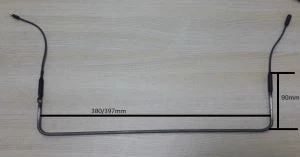
As a heat tubes supplier, I would like to recommend some of our high - quality products that can be used in efficient heat tube systems. You can check out our Anti Icing Heater, which is designed to prevent icing in various applications. Our Two Tubus Defrost Heater For Air Cooler is ideal for air cooler defrosting, and the Straight Tube Defrost Heater Two Leads offers a simple yet effective solution for defrosting needs.
Conclusion
Designing a heat tube system for maximum efficiency requires a comprehensive understanding of the principles of heat transfer, careful consideration of system design parameters, appropriate material selection, and seamless integration with other components. By following these guidelines, you can create a heat tube system that meets your specific heat transfer requirements while operating at its highest efficiency.
If you are interested in our heat tube products or need more information on heat tube system design, please feel free to contact us for procurement and further discussions. We are committed to providing you with the best solutions for your heat transfer needs.
References
- Incropera, F. P., & DeWitt, D. P. (2002). Fundamentals of Heat and Mass Transfer. Wiley.
- Kakac, S., & Pramuanjaroenkij, A. (2005). Heat Pipes: Science and Technology. Taylor & Francis.
- Carey, V. P. (1992). Liquid - Vapor Phase - Change Phenomena: An Introduction to the Thermophysics of Vaporization and Condensation Processes in Heat Transfer Equipment. Hemisphere Publishing Corporation.