What is the role of heat pipes in improving LED lifespan?
In today's world, LED (Light - Emitting Diode) technology has become ubiquitous, finding applications in a wide range of fields such as lighting, automotive lighting, and display screens. However, one of the key challenges that limit the performance and lifespan of LEDs is heat management. This is where heat pipes, as a highly efficient heat transfer device, play a crucial role. As a heat pipe supplier, I am well - aware of the significance of heat pipes in enhancing LED lifespan, and I will delve into this topic in detail.
The Problem of Heat Generation in LEDs
LEDs are semiconductor devices that convert electrical energy into light. During this process, a certain amount of electrical energy is inevitably converted into heat. Excessive heat can have several detrimental effects on LEDs. Firstly, it can cause a decrease in luminous efficiency. As the temperature of an LED increases, the internal quantum efficiency decreases, resulting in less light output for the same amount of electrical input. Secondly, high temperatures can lead to color shift. The color of the light emitted by an LED is sensitive to temperature changes, and an increase in temperature can cause the color of the light to deviate from the desired color point.
Most importantly, heat can significantly reduce the lifespan of LEDs. The junction temperature of an LED is one of the most critical factors affecting its lifespan. According to the Arrhenius equation, for every 10°C increase in junction temperature, the lifespan of an LED can be reduced by approximately half. This means that if an LED is operated at a high temperature for a long time, its lifespan will be drastically shortened, leading to frequent replacements and increased costs.


How Heat Pipes Work
Heat pipes are passive heat transfer devices that can transfer heat over long distances with very low thermal resistance. A typical heat pipe consists of a sealed tube, a wick structure, and a working fluid. The working principle is based on the phase - change process of the working fluid.
The heat pipe has an evaporator section and a condenser section. When heat is applied to the evaporator section, the working fluid inside the wick structure absorbs the heat and evaporates. The vapor then flows to the condenser section under the pressure difference. At the condenser section, the vapor releases the heat to the surrounding environment and condenses back into a liquid. The liquid is then returned to the evaporator section through the capillary action of the wick structure, completing a cycle.
This phase - change heat transfer mechanism allows heat pipes to transfer a large amount of heat with a very small temperature difference. Compared to traditional heat conduction materials such as copper and aluminum, heat pipes can achieve much higher heat transfer efficiency, making them ideal for use in heat management systems for LEDs.
Role of Heat Pipes in Improving LED Lifespan
- Efficient Heat Dissipation
Heat pipes can quickly transfer the heat generated by LEDs from the heat source (the LED chip) to the heat sink. By reducing the junction temperature of the LED, heat pipes can effectively slow down the degradation process of the LED. For example, in a high - power LED lighting system, without proper heat management, the junction temperature of the LED may rise to over 100°C. However, by using heat pipes, the junction temperature can be maintained at a much lower level, say around 60 - 70°C. This significant reduction in temperature can greatly extend the lifespan of the LED. - Uniform Heat Distribution
Heat pipes can also help to achieve a more uniform heat distribution across the LED module. In an LED array, if the heat is not evenly distributed, some LEDs may operate at a higher temperature than others, which can cause uneven light output and premature failure of the high - temperature LEDs. Heat pipes can spread the heat evenly across the heat sink, ensuring that all LEDs in the array operate at a relatively consistent temperature, thereby improving the overall performance and lifespan of the LED module. - Reliable and Long - Lasting
Heat pipes are passive devices with no moving parts, which means they have high reliability and a long service life. Unlike some active cooling devices such as fans, which may fail due to mechanical wear and tear, heat pipes can operate stably for a long time. This reliability is crucial for LED applications where continuous and stable operation is required, such as in street lighting and industrial lighting.
Real - World Applications and Case Studies
In the automotive lighting industry, heat pipes have been widely used to improve the lifespan of LED headlamps. LED headlamps need to provide high - intensity light while maintaining a long lifespan in harsh environmental conditions. By integrating heat pipes into the heat management system of LED headlamps, automotive manufacturers can ensure that the LEDs operate at an optimal temperature, reducing the risk of premature failure and improving the overall quality of the lighting system.
In large - scale display screens, such as digital billboards, heat pipes are also used to manage the heat generated by the high - power LEDs. These display screens often need to operate continuously for long periods, and heat management is essential to prevent color shift and extend the lifespan of the LEDs. Heat pipes can effectively transfer the heat from the LEDs to the external environment, ensuring that the display screens maintain good performance over time.
Additional Products for Heat Management
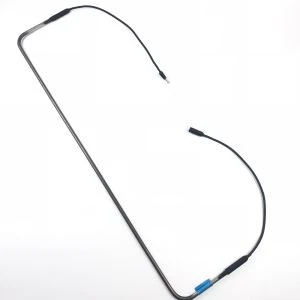
As a heat pipe supplier, we also offer other related products for heat management. For example, we have Defrosting Element Heater For Cold Room which can be used in cold room applications to prevent frost formation. Our Defrosting Tube Heater Heating Element Elements are suitable for various heating needs in industrial and commercial settings. And our Tubular Defrost Heater For Unit Cooler is specifically designed for unit coolers to ensure efficient defrosting.
Conclusion
In conclusion, heat pipes play an indispensable role in improving the lifespan of LEDs. By providing efficient heat dissipation, uniform heat distribution, and reliable operation, heat pipes can effectively reduce the junction temperature of LEDs and slow down the degradation process. This not only improves the performance and reliability of LED products but also reduces the overall cost of ownership.
If you are in need of heat pipes for your LED applications or other heat - management needs, we would be more than happy to serve you. Our team of experts can provide you with professional advice and customized solutions. Contact us for procurement and let's discuss how we can meet your specific requirements.
References
- "LED Lighting Handbook" by John C. C. Fan
- "Heat Pipes: Theory, Design and Applications" by Adrian F. Mills
- Industry reports on LED technology and heat management.